
A professional logo serves multiple simultaneous functions: immediate identification, consistency across dozens of media, and legal protection of the mark. Creating a unique logo to enhance a business requires measuring the gap between available methods, their actual deliverables, and their legal limitations. This article compares logo creation approaches based on the criteria that determine the quality of the final result.
Logo Creation: Delivered Files and Rights According to the Chosen Method
The choice of a creation method is not limited to the budget. The deliverable conditions the long-term use of the logo. A bitmap file (PNG, JPG) cannot be resized without loss, whereas a vector file (SVG, AI, EPS) adapts from favicon to billboard.
| Criterion | Free Online Generator | Paid AI Generator | Professional Graphic Designer |
|---|---|---|---|
| Delivered Formats | PNG, sometimes SVG | PNG, SVG, sometimes AI | AI, EPS, SVG, PNG, PDF |
| Variations (icon, monochrome, social media) | Rarely included | Partial | Included in the brief |
| Copyright on the Visual | Limited by terms of use | Uncertain if human input is low | Contractual transfer of rights |
| Prior Art Search (trademark) | No | No | Possible as an additional service |
| Provided Graphic Charter | No | No | Yes (usage rules, exclusion zones, colors) |
The table highlights a structural gap: generators produce an image, while a designer delivers a complete visual system with usage rules. This distinction matters when printing business cards, adapting the logo for a video, or submitting it to a printer.
Specialized platforms like maisonlogo.fr provide access to custom creations tailored to the real needs of a business, with deliverables usable across all media.

AI Logo and Trademark Registration: What the Law Really Allows
An AI-generated logo can be registered as a trademark with the INPI. Trademark law assesses the distinctiveness of the mark and conflicts with prior rights, not the creation method.
However, copyright protection remains uncertain when human input is low. In France, a machine cannot be recognized as an author. A visual deemed ordinary or produced without identifiable aesthetic choices risks receiving no copyright protection.
The terms of use of the AI tool may also limit commercial use or registration. Before any exploitation, the prior art search must cover the name, the visual, and their variants. This point remains the same, regardless of the creation method.
What This Changes Practically
An entrepreneur using an AI generator for their logo has a functional visual but not necessarily a legally protected asset. The prior art search remains necessary before any commercial use. Without this verification, a conflict with an existing trademark may require a logo change after deployment, incurring associated replacement costs.
Logo Accessibility and Contrast: WCAG 2.2 Requirements
The WCAG 2.2 standard, published on October 5, 2023, by W3C, provides an exemption for contrast for logos. The logo itself does not have to meet the contrast ratios imposed on regular text.
This exemption does not extend to elements accompanying the logo. Texts, buttons, icons, and associated interface components must meet applicable requirements: a contrast of 4.5:1 for regular text and 3:1 for large characters or certain interface elements (level AA).
Graphic Charter and Accessibility
The graphic charter must clearly distinguish the logo (exempt) from adjacent elements (subject to contrast rules). In practice, this means that:
- The logo can use colors with low contrast between them, but accompanying text (slogan, baseline) must meet the required ratio against its background
- Logo variations on dark or light backgrounds must be tested separately to verify the readability of non-exempt elements
- Contrast checking tools (like color contrast checkers) apply to interface components, not to the isolated logo
A professional logo takes these constraints into account from the design phase, not after deployment on the website.
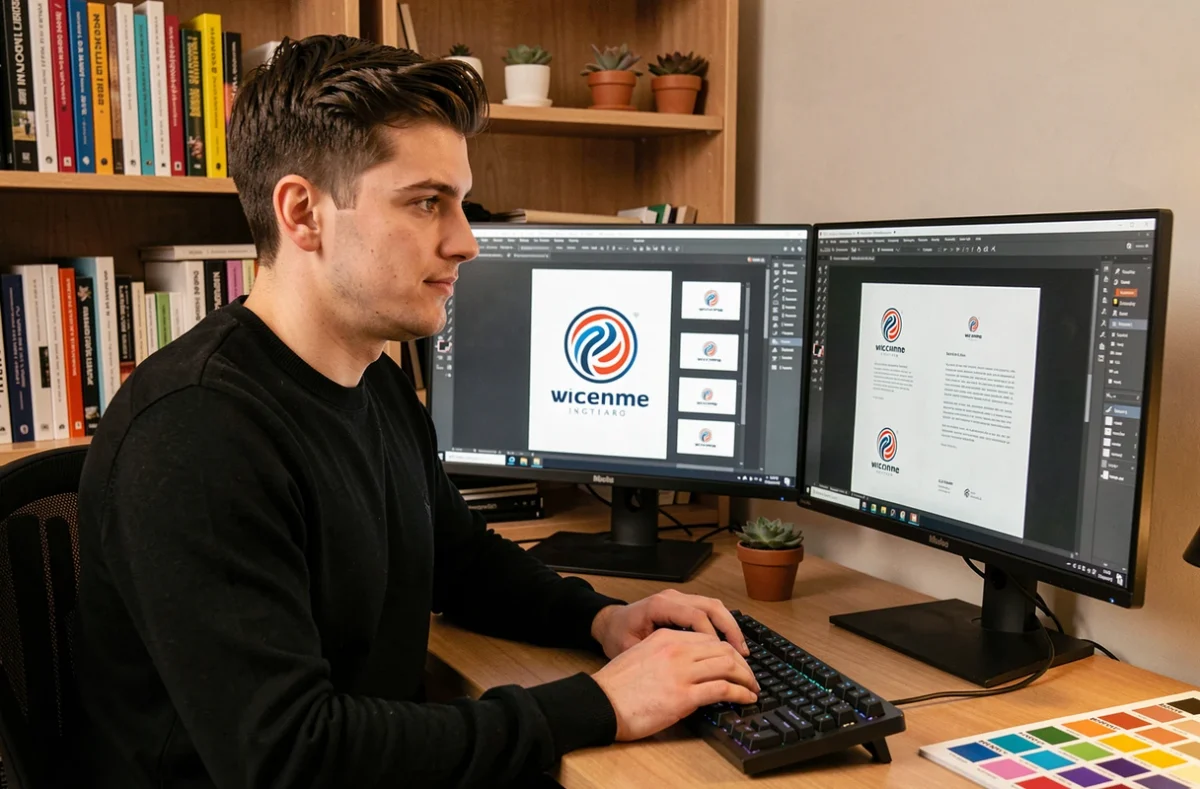
Logo Variations for Digital: What a Professional Deliverable Includes
Competitors often mention the need to “plan for variations.” The details of what this entails vary significantly.
A professional deliverable includes at least four variants: main version, icon (favicon and app), monochrome version, formats adapted for social media. Logos become adaptive, with variations by medium (story, banner, email signature, print).
- Main version in color with defined exclusion zone (minimum space around the logo)
- Simplified icon for small formats (favicon, profile avatar)
- Monochrome version for monochrome media (fax, engraving, stamp)
- Optimized web exports (SVG for sharpness, PNG with transparency) and print exports (AI, EPS, vector PDF)
The absence of these variations forces improvisation of adaptations as needs arise, which degrades the coherence of the visual identity. A logo without a system of variations loses its function as a visual marker as soon as it changes medium.
Creating a unique and professional logo is not limited to designing a symbol. The deliverable, associated rights, accessibility compliance, and variations form a whole. Evaluating a creation method solely on aesthetic criteria is akin to judging a contract by its cover.