
Transforming a house into a unique and warm space relies on both technical and aesthetic choices. The warmth of an interior depends not only on colors or furniture: it is also built through the acoustic treatment of rooms, the modularity of spaces, and the coherence between the materials used.
Acoustic comfort: the forgotten parameter of a warm interior
Most decorating advice focuses on what is visible. Acoustics, on the other hand, affects what is felt. A room where sound bounces off every hard surface creates a sensation of coldness, even with walls painted in warm tones.
Reducing reverberation radically transforms the atmosphere of an open room. In homes where the kitchen, living room, and office share the same volume, noise spreads without obstacles. Dense-weight rugs, thick curtains, and filled bookshelves absorb a significant portion of these sound reflections.
Textile wall panels provide both a decorative and functional solution. Fixed behind a sofa or in a hallway, they break up reverberation while adding texture. This is particularly useful when remote work coexists with family life in the same space. To explore other concrete layout options, the sheets published on idees-maison.com detail approaches tailored to each housing configuration.

Materials and colors: composing a coherent palette for your interior decoration
The choice of materials precedes that of colors. Light raw wood, polished concrete, or matte tiles do not call for the same wall shades. Starting from the dominant material in the room helps avoid artificial associations.
Combining materials before colors
Recent trends favor matte finishes and deep textures. Linen, stoneware, unvarnished oak, or terracotta create a visual base that is almost self-sufficient. Adding a strong color on a single wall works better than distributing several bright shades throughout the room.
A dark matte accent wall visually enlarges the depth of a room when paired with low-angle lighting. This technique works in both living rooms and bedrooms, provided other surfaces are kept to neutral tones.
Textiles as a binding element between materials
Cushions, throws, and rugs are not just accessories. They ensure the transition between hard materials (floor, walls, furniture) and the body. A fabric sofa placed on raw flooring with a thick wool rug creates a sensory coherence that furniture alone cannot offer.
- Favor textiles whose fibers pick up a shade already present in the wood or stone of the room, to avoid a catalog effect.
- Vary thicknesses: a light sheer at the window, a lined curtain for insulation, a textured throw on the seat.
- Avoid shiny synthetic fabrics that break the matte effect sought by the surrounding natural materials.
Modular furniture: adapting the space to your daily uses
Living spaces in urban environments push us to rethink the function of each piece of furniture. A piece of furniture that serves only one purpose takes up space without creating value. Modularity is not a gimmick: it meets a concrete need to accommodate multiple activities within the same volume.
Extendable tables, benches with integrated storage, and foldable desks allow for reconfiguring a room in seconds. Utilizing verticality (high shelves, suspended storage) frees up the floor and gives a more generous sense of space.
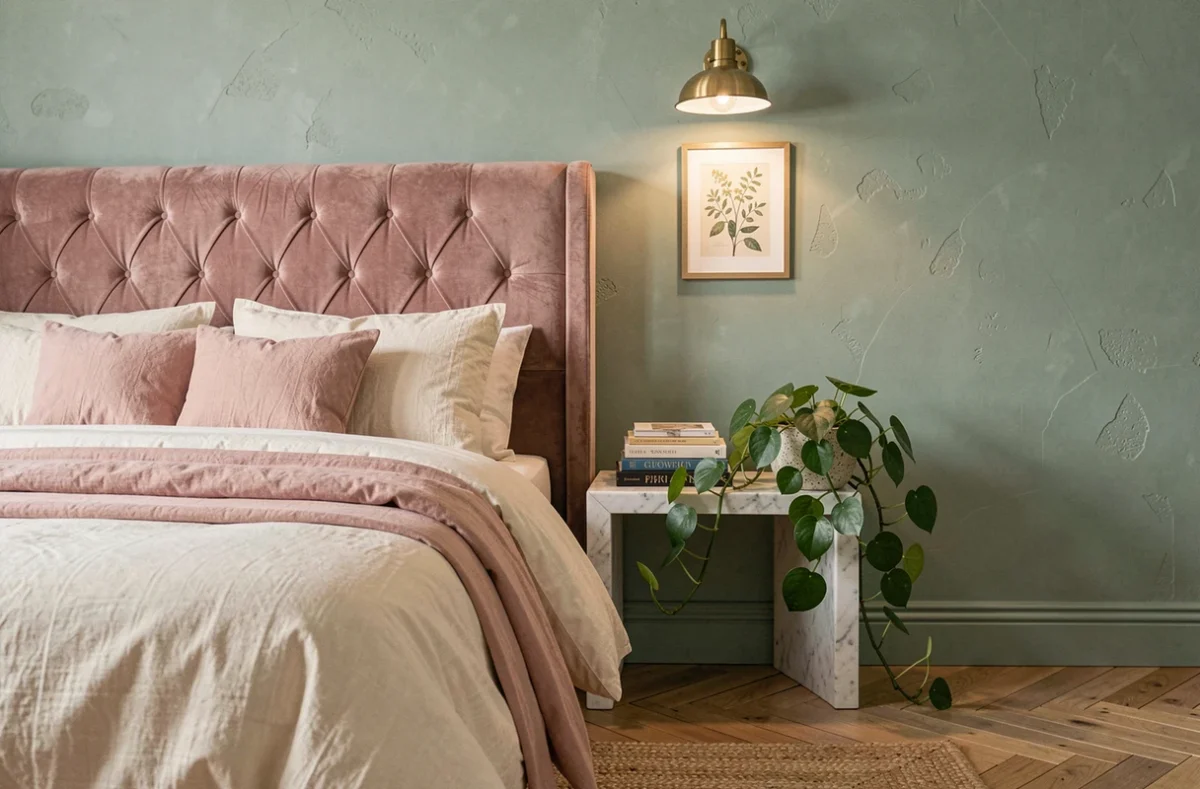
Before buying a piece of furniture, a simple question suffices: will this piece be used the same way in the morning and in the evening? If the answer is no, traditional fixed furniture limits possibilities. Modularity begins with observing one’s own routines, not with an impulsive purchase.
Natural and artificial light: structuring lighting room by room
Lighting is the factor that most alters the perception of a space, more than the color of the walls. A room well-lit with natural light during the day can become cold and flat in the evening if the artificial lighting is limited to a central ceiling fixture.
Increasing natural light without glazing everything
White or ecru sheers diffuse light without creating glare. Placing a mirror opposite a window reflects light into the darker areas of the room. A well-positioned mirror is equivalent to an additional light source without any electrical consumption.
Layering artificial sources
Three levels of lighting cover the majority of domestic needs:
- General lighting (ceiling fixture or pendant) ensures overall visibility but should never be the only source turned on in the evening.
- Task lighting (desk lamp, reading light, kitchen spots) targets a specific task and can remain in neutral white temperature.
- Ambient lighting (string lights, table lamps, candles) uses warm tones and creates comfort zones that make an interior welcoming.
Layering these three levels gives total control over the atmosphere of a room, regardless of the time or activity taking place.
A warm interior rarely results from a single decorative gesture. It is the interplay between controlled acoustics, coherent materials, furniture adapted to real uses, and stratified lighting that creates a place where one feels good for the long term. Each room deserves to be treated according to its own function, not according to a recipe uniformly applied to the entire home.